



























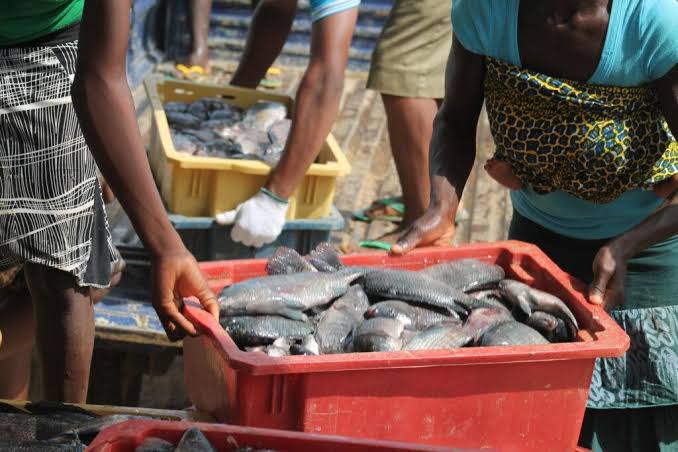
The Federal Government has identified high fish-feed costs, inadequate access to quality seed and broodstock, poor financing and weak fish-health systems as major factors hampering fish production in Nigeria.
Minister of Marine and Blue Economy, Dr Adegboyega Oyetola, disclosed this on Thursday in Abuja while inaugurating the Technical Committee on Accelerating Fish Production in Nigeria.
Oyetola said the challenges had widened the gap between domestic fish production and national demand, with consequences for food security, household income and foreign exchange.
“Domestic production remains substantially below national demand, with consequences for food security, household incomes and foreign-exchange resources,” he said.
Other challenges identified by the minister included post-harvest losses, inadequate cold-chain and storage infrastructure, research and innovation gaps, weak data systems, inadequate standards and traceability, and poor market development.
He said high production costs, particularly fish feed, were preventing farmers from expanding their operations, while inadequate access to quality seed and broodstock was limiting productivity.
The minister also noted that weak fish-health and biosecurity systems and insufficient cold-chain infrastructure continued to expose the sector to production risks and post-harvest losses.
Oyetola said the transfer of fisheries and aquaculture functions to the Ministry of Marine and Blue Economy had created a stronger institutional platform for addressing the challenges.
He reaffirmed the government’s commitment to increasing sustainable domestic fish production, strengthening the fisheries value chain and reducing dependence on imported fish.
The minister recalled that his ministry, in collaboration with the National Institute for Policy and Strategic Studies (NIPSS), held a strategic roundtable on October 29, 2025, to examine ways of accelerating fish production.
He said the newly inaugurated committee would assess the recommendations from that meeting and convert viable proposals into an actionable roadmap.
“Your assignment is not to develop another policy or establish a parallel programme,” Oyetola told the committee.
He directed members to assess the recommendations against existing policies, laws, government programmes and institutional mandates and determine which should be adopted, modified, integrated into existing frameworks or subjected to further study.
The committee is also expected to map existing initiatives by government, the private sector and development partners to prevent duplication and ensure more efficient use of resources.
Oyetola said its final report must contain an implementation matrix outlining priority interventions, responsible institutions, timelines, indicative costs, funding options, performance indicators and necessary approvals.
It is also expected to identify opportunities for private-sector investment, public-private partnerships and development financing.
The committee, chaired by the ministry’s Permanent Secretary, Mrs Fatima Sugra Mahmood, has eight weeks to submit its report.
© 2026, Standard Focus. All rights reserved. This material, and other digital content on this website, may not be reproduced, published, broadcast, rewritten or redistributed in whole or in part without prior express written permission from STANDARD FOCUS.