



























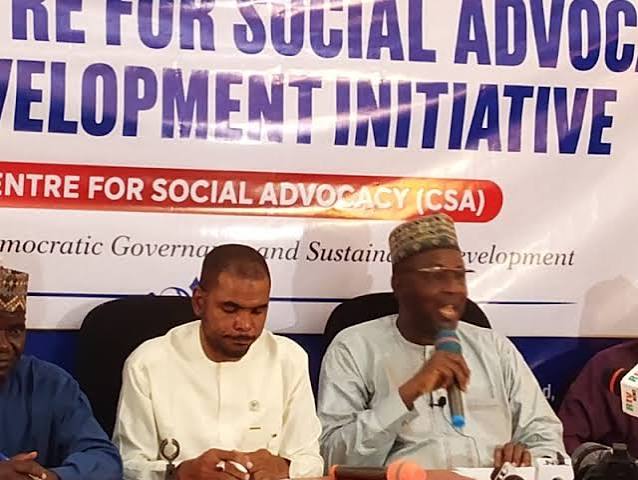
The Aminchi Centre for Social Advocacy and Community Development Initiative has rejected the 14-day ultimatum issued by the Muslim Rights Concern (MURIC) to the Minister of Defence, Gen. Christopher Musa (rtd.), over killings in Sokoto State.
MURIC had demanded an end to the killings or the resignation of the Defence Minister.
However, the Aminchi Centre described the ultimatum as “misplaced, constitutionally flawed,” arguing that it reduced a complex national security crisis to the responsibility of one individual.
In a rejoinder signed by its Chairman and Chief Executive Officer, Ibrahim Abdullahi Shuni, the organisation said Nigerians had every right to demand accountability over killings, kidnappings and insecurity.
It, however, said such demands must recognise the constitutional and institutional structure governing national security.
According to the centre, the Defence Minister is responsible for policy direction, oversight, resource mobilisation, procurement, administration and strategic coordination but “is not the Commander-in-Chief of the Armed Forces.”
The organisation explained that the 1999 Constitution vests the President, as Commander-in-Chief, with authority over the operational deployment of the Armed Forces.
It therefore argued that it was misleading to portray the Defence Minister as the sole authority responsible for military operations and security incidents.
The centre said tackling terrorism, banditry and kidnapping required coordinated action by the Presidency, Armed Forces, police, intelligence agencies, state and local governments, traditional institutions, religious leaders, communities and citizens.
It challenged MURIC to complement its criticism with practical contributions by disclosing intelligence it had provided, criminal networks it had helped expose and communities it had mobilised for early-warning systems.
“National security cannot be reduced to press releases,” the centre declared.
The organisation also questioned why MURIC had singled out the Defence Minister when several institutions and levels of government are involved in Nigeria’s security architecture.
It asked why similar demands had not been directed at the President and Commander-in-Chief, Service Chiefs, police and intelligence agencies, as well as the Sokoto State Government, local governments, traditional rulers and community leaders.
The centre warned that reducing the security crisis to a demand for one minister’s resignation could transform a serious national emergency into a “political or personality contest.”
It nevertheless stressed that its position should not be interpreted as opposition to accountability.
The organisation said the Defence Minister, Armed Forces and other security agencies must be held accountable for responsibilities legally assigned to them.
However, it argued that accountability should be based on law, facts, institutional responsibilities and measurable performance rather than an “arbitrary 14 day deadline.”
It also rejected the expectation that Sokoto could become completely secure within 14 days.
Instead, the centre said security performance should be measured through improved intelligence gathering, prevention of attacks, dismantling of criminal networks, rescue of victims, protection of vulnerable communities, prosecution of offenders and stronger inter-agency coordination.
It urged MURIC and other civil society organisations to engage security agencies constructively while supporting community intelligence networks, early-warning mechanisms, victims of violence and programmes against radicalisation and violent extremism.
The centre also called for stronger citizen participation, noting that criminals often depend on local informants, financiers, safe havens and support networks.
While describing Gen. Musa as “a son of the soil of the Seat of the Caliphate” who understands the suffering of the people, the organisation said he must nevertheless be assessed objectively based on his legal responsibilities, available resources and measurable security outcomes.
The centre concluded that MURIC had the right to demand government action but “is not constitutionally empowered to determine the tenure of a Federal Minister.”
It stressed that the appointment or removal of ministers remained the constitutional prerogative of the President.
The organisation condemned the killings across Sokoto and Nigeria and urged stakeholders to shift attention from “who should we blame?” to “what can each of us do to help Nigeria defeat terrorism, banditry, kidnapping and violent crime?”
© 2026, Standard Focus. All rights reserved. This material, and other digital content on this website, may not be reproduced, published, broadcast, rewritten or redistributed in whole or in part without prior express written permission from STANDARD FOCUS.