
















By Edwin Ebulu
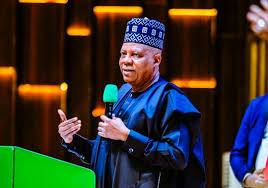
Vice President Kashim Shettima has described Nasarawa State as a clear example of how Nigeria’s federating units are becoming economically viable under the administration of President Bola Tinubu, citing improved infrastructure, enterprise support and human capital development.
Shettima made the remarks on Wednesday while delivering the keynote address at the third Nasarawa Economic Summit held at the Aliyu Akwe Banquet Hall, Government House, Lafia.
He said the transformation witnessed in Nasarawa reflected the impact of improved governance and stronger fiscal capacity of states under ongoing national reforms.
“Ten years ago, Lafia was a small rural outpost struggling to wear the looks of modernity. Today, it is adorned with flyovers, good roads and modern edifices a product of good governance,” he said.
According to him, the developments illustrate the meaning of a “working federation,” where stronger federal finances and increased state revenues are translating into visible development at the grassroots.
“This is the meaning of a working Federation: when the centre is stronger, the states can breathe. When states receive more revenues, communities feel the presence of government,” Shettima stated.
He added that sub-national governments are increasingly becoming hubs of enterprise, innovation and industrial activity.
The Vice President commended Governor Abdullahi Sule and his administration for what he described as consistent and disciplined governance focused on long-term development.
He also noted that Nasarawa State’s abundant natural resources, including agriculture, solid minerals and energy potential, positioned it as a strong investment destination, especially given its proximity to the Federal Capital Territory.
“Investors, policymakers, entrepreneurs and development partners are discovering areas of mutual interest. It is where the imagination of government meets the courage of private enterprise,” he said.
Shettima expressed optimism that the state would continue on its growth trajectory beyond the current administration, stressing the importance of leadership succession in sustaining reforms.
“Success is not achieved until there is a good successor. Development must be transferred from one generation of leadership to the next without rupture,” he added.
In his remarks, Governor Abdullahi Sule said the Nasarawa Investment Summit, which began in 2022, has become a key platform for showcasing the state’s economic direction and attracting private sector partnerships.
He recalled that previous editions focused on repositioning the state from untapped potential to structured development, with themes such as “Diamond in the Rough” and “Industrial Renaissance.”
According to him, the 2026 edition, themed “Bold Transition: Building a Legacy for Sustainable Development,” is aimed at consolidating reforms and ensuring continuity beyond political transitions.
Sule described the summit as a defining moment in the state’s governance and economic journey, adding that it is designed to institutionalise reforms and strengthen investor confidence.
“This theme reflects the need to ensure that reforms and institutional systems developed over the years are sustained, deepened and embedded beyond political cycles,” he said.
He added that the summit also seeks to reassure investors of policy continuity, institutional stability and predictable governance.
The Governor disclosed that over $2 billion in investment inflows had already been recorded in the state, crediting the progress to deliberate policy direction and investment promotion efforts.
Earlier, the Managing Director of the Nasarawa Investment and Development Agency (NASIDA), Ibrahim Abdullahi, said the focus of the summit had shifted from attracting investment to sustaining it.
He said the 2026 summit is designed to ensure that reforms endure beyond leadership transitions and continue to drive economic growth.
Abdullahi also highlighted several investment-ready projects, including agro-industrial hubs, renewable energy initiatives, solid minerals processing, infrastructure funds and transport corridor developments.
The two-day summit features discussions on institutional reforms ahead of the 2027 elections, investor requirements for capital commitment, gas development plans and energy access challenges, among others.
© 2026, Standard Focus. All rights reserved. This material, and other digital content on this website, may not be reproduced, published, broadcast, rewritten or redistributed in whole or in part without prior express written permission from STANDARD FOCUS.