


































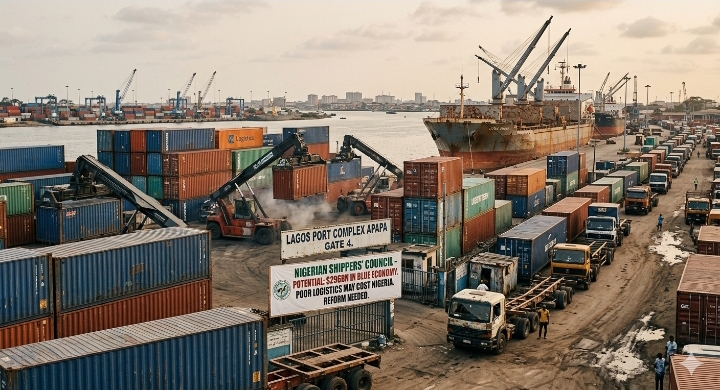
Nigeria could forfeit an estimated $296 billion in blue economy opportunities if longstanding weaknesses in maritime logistics and transport connectivity persist, the Nigerian Shippers’ Council (NSC) has warned.
Executive Secretary and Chief Executive Officer of the NSC, Akutah Pius, raised the alarm on Thursday at the Blue Economy Summit in Abuja, citing inadequate investment in maritime infrastructure as a major constraint to the country’s growth in the sector.
Despite boasting over 800 kilometres of coastline and more than 10,000 kilometres of inland waterways, Akutah said Nigeria has been unable to fully harness its maritime potential due to inefficient cargo movement systems and weak logistics networks.
He pointed to recurring bottlenecks in port operations, particularly in cargo evacuation, as well as poor linkages between seaports and inland destinations, which continue to drive up costs, cause delays and reduce overall efficiency.
“Nigeria has vast blue economy potential, but without efficient logistics and connectivity, these opportunities remain largely untapped,” he said.
Akutah further noted that the absence of seamless integration between ports, inland waterways and hinterland transport systems has weakened Nigeria’s competitiveness under the African Continental Free Trade Area (AfCFTA).
He added that a significant portion of intra-African trade still moves through Europe and Asia due to poor regional connectivity, describing the trend as a major setback for economic integration on the continent.
According to him, expanding inland waterways and coastal shipping would offer a cheaper alternative to road transport, ease congestion at the ports and improve efficiency across the logistics chain.
He warned that without urgent reforms in maritime governance and infrastructure investment, Nigeria may continue to underperform in the blue economy space.
Akutah therefore called for stronger collaboration between government and the private sector to address logistics gaps and accelerate infrastructure development, stressing that efficient maritime systems are critical to reversing the projected losses and positioning Nigeria as a regional trade hub.
Also speaking, the Minister of Marine and Blue Economy, Adegboyega Oyetola, reaffirmed the Federal Government’s commitment to strengthening regulations and creating a conducive environment for investment in the sector.
He said ongoing reforms are aimed at promoting transparency, accountability and investor confidence, while urging stakeholders to ensure that deliberations at the summit translate into concrete outcomes such as increased investments, policy execution and sustainable partnerships.
“To investors, Nigeria offers scale and opportunity in a stable environment. The time to act is now,” he said.Oyetola expressed optimism about the future of the maritime sector, envisioning globally competitive ports, a thriving shipping industry and a fisheries sector capable of meeting domestic demand and boosting exports.
He added that a well-developed blue economy could generate millions of jobs, particularly for young Nigerians, while strengthening the country’s position as a leading maritime hub in Africa.
“I see a nation whose waters become channels of prosperity, but decisive action is required to realise this vision,” he said.
In her remarks, Convener of the Maritime Innovations Hub, Princess Ronke Kosoko, described the summit as timely, noting that Nigeria must urgently diversify its economy beyond oil.She identified the blue economy as a key driver of sustainable growth but warned that structural bottlenecks particularly bureaucratic delays and weak coordination continue to hinder progress.
Kosoko revealed that while investors have shown interest in opportunities across inland waterways and coastal corridors, many projects remain stalled due to slow approval processes and regulatory inefficiencies.
“What Nigeria needs now is speed and alignment. Investors are ready, but the system must respond faster,” she said.
She also stressed the growing importance of inland waterways in supporting industrial sectors such as manufacturing, agriculture and refining, while raising concerns over workforce preparedness.
According to her, Nigeria risks losing job creation opportunities if deliberate steps are not taken to equip young people with relevant skills for the maritime industry.
Kosoko called for stronger collaboration among government agencies, private investors and development partners to unlock the sector’s full potential.
She expressed confidence that with the right policies, infrastructure and commitment, Nigeria can transform its vast water resources into a major driver of economic growth and regional trade leadership.
© 2026, Standard Focus. All rights reserved. This material, and other digital content on this website, may not be reproduced, published, broadcast, rewritten or redistributed in whole or in part without prior express written permission from STANDARD FOCUS.