









































By Sadiq Bello, Abuja
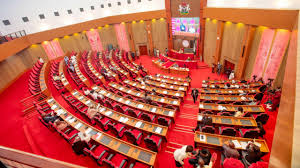
ABUJA — A bill seeking to increase the statutory allocation to the Nigeria Police Trust Fund from 0.5 per cent to 1 per cent of revenue accruing to the Federation Account has scaled second reading in the Senate, sparking robust debate over its constitutional and fiscal implications.
The proposed legislation, titled the Nigeria Police Trust Fund (Establishment) Bill, 2025, is designed to overhaul the funding framework for the Nigeria Police Force by repealing the 2019 Act and introducing a more comprehensive legal and institutional structure.
Sponsored by the Senate Leader, Senator Opeyemi Bamidele (APC, Ekiti Central), the executive bill aims to address persistent challenges in policing, including inadequate funding, outdated equipment, poor welfare, and weak infrastructure.
Lawmakers, however, raised concerns during plenary about the implications of increasing the statutory deduction from the Federation Account.
Following deliberations, the Senate adopted the bill through a voice vote and referred it to the Committee on Police Affairs, which has been mandated to report back within two weeks.
Leading the debate, Bamidele described the bill as a strategic intervention to strengthen national security, noting that emerging threats such as insurgency, banditry, kidnapping, and cybercrime demand a modern, well-funded policing system.
He explained that the bill proposes a diversified funding model anchored on 1 per cent of total Federation Account revenue, alongside development levies, government interventions, international grants, and private sector contributions.
“The objective is to establish a more robust, transparent, and accountable Nigeria Police Trust Fund,” Bamidele said. “It will ensure predictable and sustainable funding, enhance operational and technological capacity, improve personnel welfare, and align policing strategies with global standards.”
He added that the proposed framework includes a strengthened governance structure featuring a multi-stakeholder board and a Project Implementation Committee to boost transparency, accountability, and efficiency.
According to him, the funds would be deployed to priority areas such as acquisition of modern security equipment, deployment of digital surveillance and forensic technologies, rehabilitation of police facilities, capacity building, intelligence gathering, emergency response, and improved welfare packages for personnel.
Despite broad support for improved police funding, several senators expressed reservations. Senator Ibrahim Dankwambo (PDP, Gombe North) questioned the legality of increasing the allocation without amending the Constitution and raised concerns about its compatibility with ongoing discussions on state policing.
Deputy President of the Senate, Senator Barau Jibrin (APC, Kano North), dismissed the constitutional fears, arguing that the proposal applies uniformly and does not contravene existing laws.
Senator Abdul Ningi (PDP, Bauchi Central), while backing the bill, warned that the increase could significantly shrink distributable funds in the Federation Account. “When you look at one per cent of total revenue accruing to the Federation Account, that’s really huge,” he said, also flagging accountability issues around donor contributions.
Senator Adamu Aliero (APC, Kebbi Central) welcomed the inclusion of private sector representatives on the proposed board, saying it could enhance transparency. However, he cautioned that buy-in from state and local governments would be critical to avoid legal disputes.
“Even the existing 0.5 per cent allocation was challenged by governors as unconstitutional,” Aliero noted. “We must ensure that any new law aligns with constitutional provisions governing revenue sharing.”
On his part, Senate Minority Leader, Senator Abba Moro (PDP, Benue South), strongly supported the bill, stressing that chronic underfunding has weakened the police and left officers ill-equipped to confront increasingly sophisticated criminals.
Similarly, Senate Whip, Senator Tahir Monguno (APC, Borno North), argued that the proposal is constitutionally valid if enacted by the National Assembly, citing provisions of Section 80(2) of the 1999 Constitution.
In his remarks, Senate President Godswill Akpabio acknowledged the concerns raised, noting that even the current 0.5 per cent allocation had faced legal challenges. He emphasized the need for careful scrutiny of constitutional and accountability issues during the public hearing stage.
Akpabio also underscored the importance of strict oversight mechanisms to prevent misuse of funds and ensure that increased allocations translate into tangible improvements in policing nationwide.
© 2026, Standard Focus. All rights reserved. This material, and other digital content on this website, may not be reproduced, published, broadcast, rewritten or redistributed in whole or in part without prior express written permission from STANDARD FOCUS.